Drone videography is a form of aerial videography that uses unmanned aerial vehicles equipped with stabilized, high-resolution cameras to capture motion footage from elevated viewpoints. It adds a fresh perspective to visual storytelling, offering creative flexibility and the ability to capture sweeping single-shot sequences that elevate audience engagement.
Aerial shots once expensive and exclusive to helicopters are now accessible through drone technology, enhancing storytelling by adding scale, emotion, and depth to brand films, real estate marketing, documentaries, and live event coverage. Its development followed the path of aerial photography, beginning with cameras mounted on early aircraft in the 1910s, advancing through helicopter cinematography in the mid-1900s, and reaching its modern form with the rise of consumer and professional drones in the 2010s.
Today, drone videography is priced by the hour, on a flat rate, or as a package deal, with prices ranging from $150 to $2,500 or more per project. This pricing flexibility has made aerial videography accessible to industries such as real estate, film production, weddings, construction, tourism, agriculture, and journalism.
In real estate, drone footage enhances property listings by providing aerial tours that showcase the layout and surroundings of a home or commercial building. In agriculture, drones monitor crop health and field conditions to support data-driven decisions. In construction and infrastructure inspection, drones capture detailed aerial imagery for safety compliance and project monitoring.
Drone videography also plays an increasingly important role in emergency response, journalism, and live event coverage, providing real-time aerial perspectives that traditional cameras cannot match.
Modern drone videography combines technical operation, cinematic composition, and post-production editing. It requires knowledge of frame rates, codecs, color profiles, movement techniques, and federal aviation regulations, while accounting for environmental conditions, battery life, and storage constraints.
Commercial drone operators must obtain certifications such as the FAA Part 107 in the United States or the A2 Certificate of Competency (A2 CofC) and General Visual Line of Sight Certificate (GVC) in the United Kingdom to legally operate drones for commercial purposes. By balancing flight skill, camera control, and creative direction, drone videography has become a practical tool for visual storytelling, marketing, and commercial documentation across nearly every industry.
How Much Does Drone Videography Cost?
The cost of drone videography ranges from $150 to $2,500 or more per project, depending on the pricing model, video length, location, drone class, pilot experience, and post-production complexity. Pricing is typically structured around hourly rates, flat project fees, or bundled packages. For a deeper breakdown of aerial pricing for property listings specifically, see the real estate videography pricing guide.
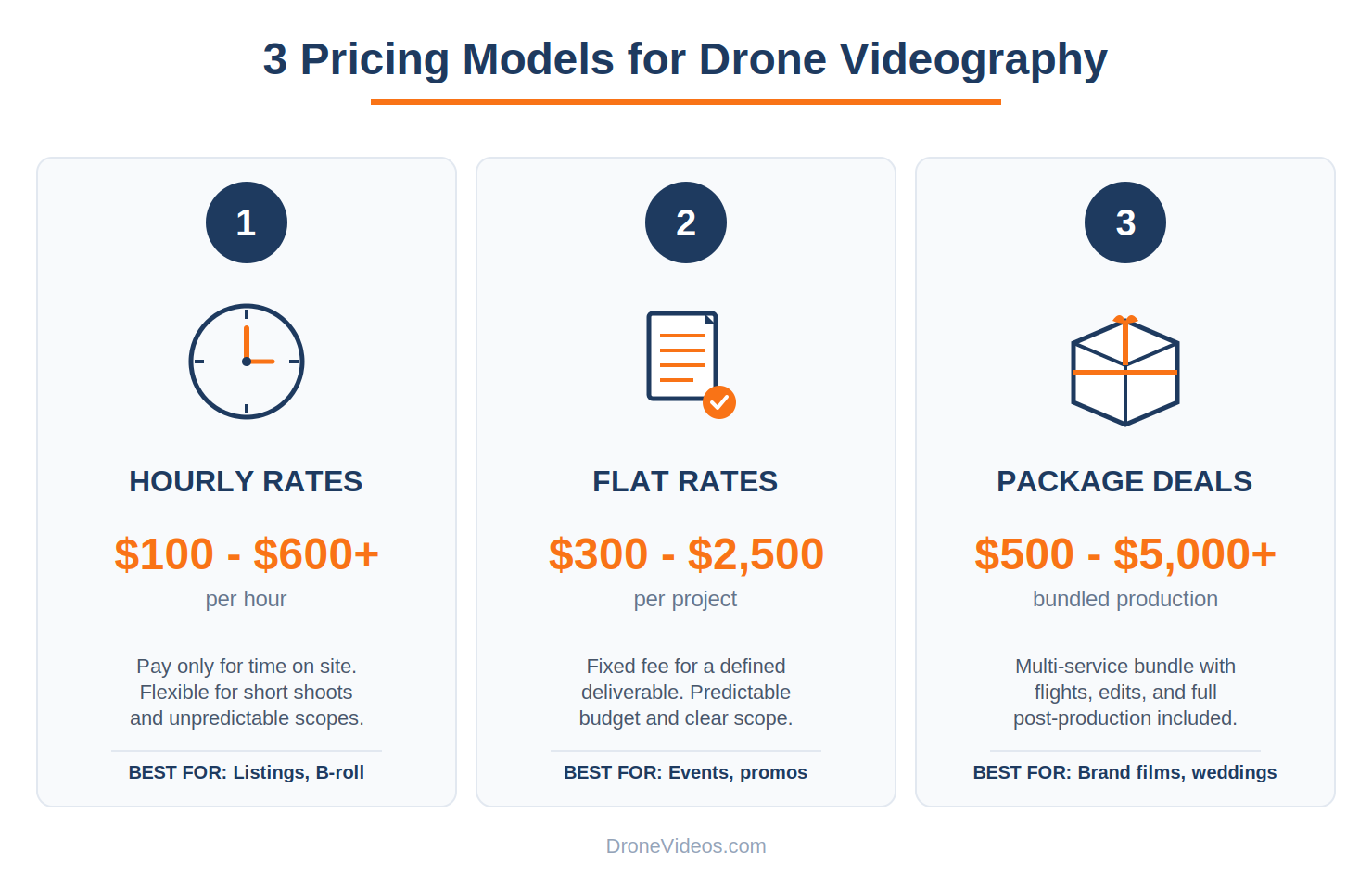
Drone videography costs based on different pricing models:
- Hourly Rates: Hourly rates for drone videography range from $100 to $500 or more per hour. Entry-level operators with consumer-grade drones charge $100 to $200 per hour for short shoots. Mid-level professionals with prosumer drones such as the DJI Mavic 4 Pro charge $200 to $350 per hour, while cinema-grade operators flying the DJI Inspire 3 or Freefly Alta X charge $400 to $500 or more per hour, which often includes a separate camera operator alongside the pilot.
- Flat Rates: Flat-rate drone videography typically runs from $150 to $2,500 or more per project for standard work such as real estate listings, event highlight reels, or short promotional videos. Flat-rate pricing covers a defined deliverable: a set number of finished video minutes, basic color correction, music licensing, and one round of revisions. This model suits clients who need predictable budgets and clear scope.
- Package Deals: Package deals for drone videography start at $500 and can exceed $2,500 for full production work. Packages combine multiple flights, aerial photos and video, ground footage, advanced color grading, music synchronization, sound design, and multi-version delivery for different platforms. Wedding films, commercial campaigns, tourism promotions, and construction time-lapses commonly use this model because they require coordinated shooting days and longer edit timelines.
How Did Drone Videography Evolve Over Time?
Drone videography evolved from early aerial cinematography experiments in the 20th century into today’s compact, AI-assisted aerial filming systems. Historically, capturing aerial shots was prohibitively expensive and reserved for major film productions, but drone technology has now made aerial cinematography accessible to a much wider range of creators. The earliest moving aerial footage came from cameras mounted on biplanes during the 1910s and 1920s, where filmmakers like William Wellman captured aerial sequences for productions such as “Wings” (1927). These flights were dangerous, expensive, and limited in stability.
From the 1930s through the 1980s, helicopter cinematography became the standard for aerial filming. Stabilized camera mounts such as the Tyler Mount (1961) and later the Wescam and Cineflex systems made smooth aerial footage possible, but renting a helicopter and pilot cost between $2,000 and $10,000 per hour, restricting aerial videography to major productions and broadcast operations.
In the 1990s and 2000s, hobbyist radio-controlled aircraft began carrying small consumer cameras. These early systems lacked stabilization, GPS, and reliable transmission, but they signaled a shift toward unmanned aerial filming. The breakthrough came in 2013 when DJI released the Phantom 2 Vision, the first ready-to-fly drone with an integrated camera, followed by the Phantom 3 in 2015, which added 4K video capability.
Between 2015 and today, drone videography matured into a professional discipline. Three-axis gimbal stabilization, intelligent flight modes such as ActiveTrack and Waypoints, log color profiles for cinematic grading, and sensors capable of 5.1K, 6K, and 8K capture have transformed drones into legitimate cinema tools. The DJI Inspire 3 with the Zenmuse X9-8K Air brought full-frame ProRes RAW recording to a flying platform, while compact systems like the DJI Mavic 4 Pro and Autel EVO II Pro put broadcast-quality video into the hands of solo operators. First-person view (FPV) technology has further advanced the craft by allowing creators to capture immersive, dynamic footage directly from the drone’s perspective.
What Are the Uses of Drone Videography?
Drone videography is used across industries that benefit from motion, scale, and elevated perspective. Aerial video footage communicates spatial relationships, movement, and atmosphere in ways that still images and ground-based video cannot. By combining cinematic motion with bird’s-eye context, drone videography supports marketing, documentation, storytelling, and analysis.
Common uses of drone videography:
- Real Estate and Architecture: Drone videography helps real estate listings stand out by combining sweeping property reveals, neighborhood context shots, and smooth flythroughs in a single video. Aerial video is now standard for luxury and commercial property marketing.
- Film and Television Production: Drones replaced helicopter cinematography in many productions because they fly lower, closer, and at a fraction of the cost. Films, commercials, and music videos use drones for tracking shots, reveal shots, dolly moves, and chase sequences.
- Weddings and Events: Drone videography captures the full scope of outdoor weddings, festivals, and corporate events without disrupting attendees. Aerial reveal shots of ceremony venues and rising establishing shots are now signature elements of modern wedding films.
- Construction and Infrastructure: Construction firms use drone videography for progress documentation, site flyovers, and stakeholder updates. Weekly or monthly aerial videos compress months of work into short timelapses, while infrastructure inspections of bridges, towers, and pipelines benefit from continuous aerial video.
- Tourism and Hospitality: Hotels, resorts, golf courses, and destination marketing organizations rely on drone videography to showcase sweeping landscapes, oceanfront properties, and amenity tours.
- Agriculture and Environmental Monitoring: Drones monitor crop health, track wildlife populations, and document changes in forests, coastlines, and other ecosystems for research and conservation purposes.
- Journalism and Documentary: News teams and documentary filmmakers use drones to safely cover wildfires, floods, protests, and remote events where helicopter coverage is unsafe, restricted, or cost-prohibitive.
- Sports and Action Filming: FPV drones capture high-speed, dynamic footage of athletes, vehicles, and stunts. Cliff diving series, motorsports broadcasts, and ski film productions regularly use FPV drones to follow subjects through environments where traditional cameras cannot reach.
- Emergency Response and Search and Rescue: Drones provide real-time aerial footage that assists in assessing emergency situations, guiding rescue operations, and surveying disaster zones safely.
What Are the Types of Drone Videography?
The types of drone videography are classified by shot style, technical method, and industry application. Each type serves a specific creative or functional purpose, and most drone videographers combine several types within a single project.
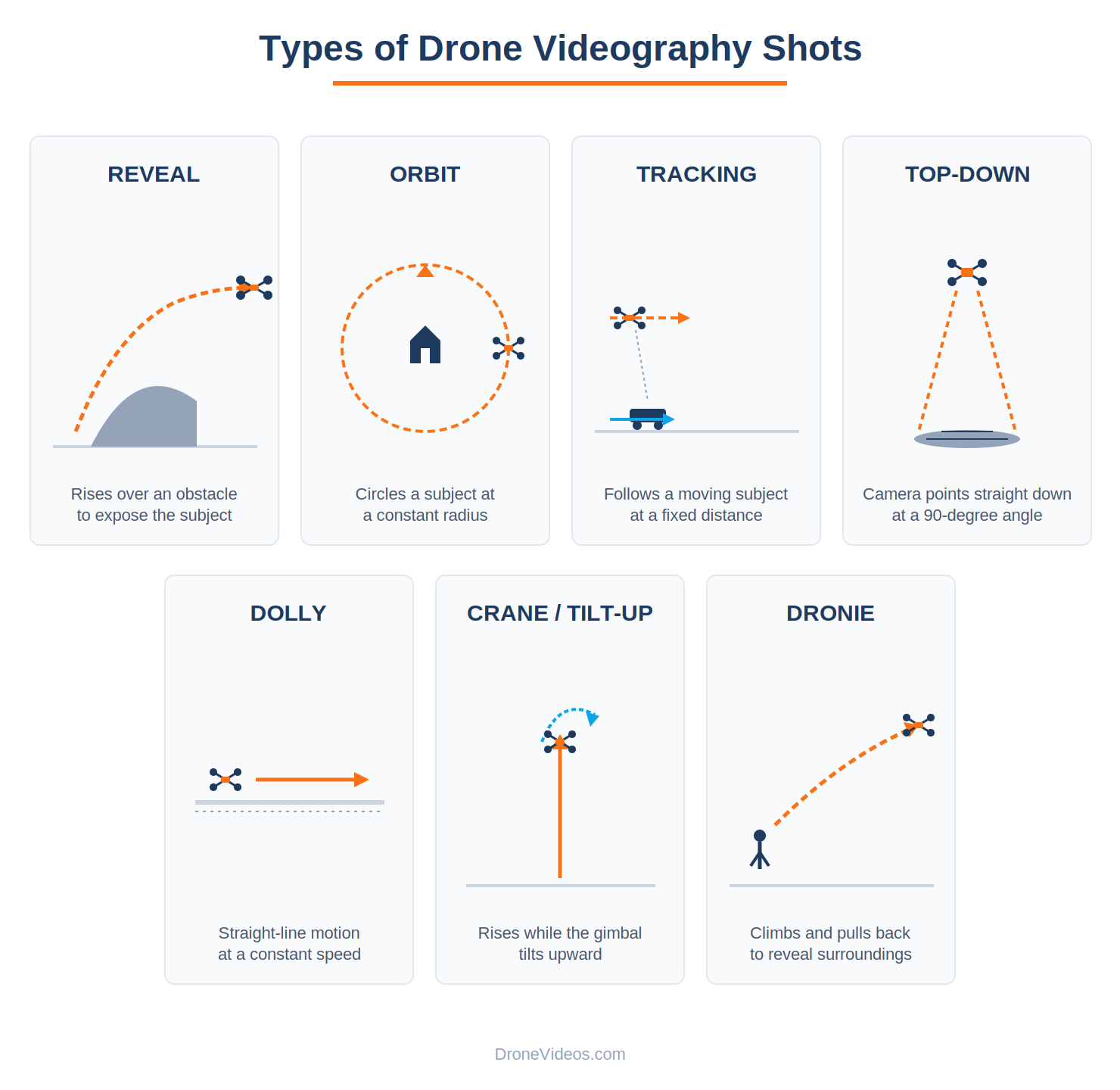
Types of Drone Videography Shots by Style
- Reveal Shots: A reveal shot starts behind an object or terrain feature, then rises or moves forward to expose a landscape, building, or subject. Reveal shots create visual surprise and are commonly used as opening shots.
- Orbit Shots: The drone circles a stationary subject at a constant radius and altitude, keeping the subject framed in the center. Orbit shots showcase three-dimensional structure and are ideal for properties, monuments, and event venues.
- Tracking Shots: The drone follows a moving subject from behind, in front, or to the side, maintaining consistent distance. Tracking shots are essential for sports, vehicle promotions, and action sequences.
- Top-Down (Bird’s-Eye) Shots: The camera points straight down at a 90-degree angle, capturing patterns, geometry, and scale. Top-down shots work well over coastlines, agricultural fields, and crowds.
- Dolly Shots: A straight forward, backward, or sideways move at constant speed. Dolly shots provide cinematic, controlled motion that mimics traditional camera dollies on tracks.
- Crane and Tilt-Up Shots: The drone rises vertically while the gimbal tilts up, creating a dramatic upward motion that scales an object or scene from ground to sky.
- Dronie Shots: A reverse fly-away shot that begins close to the subject, then climbs and pulls back simultaneously, revealing the subject within a larger environment.
Types of Drone Videography by Technical Method
- Cinematic Drone Videography: Uses cinema drones such as the DJI Inspire 3, with full-frame sensors, log color profiles, and ProRes RAW recording. Designed for film, broadcast, and high-end commercial production.
- Standard Aerial Videography: Uses prosumer drones such as the DJI Mavic 4 Pro, Air 3S, or Autel EVO II Pro. The standard for real estate, weddings, marketing, and most commercial applications.
- FPV (First Person View) Videography: The pilot wears goggles and flies an agile, custom-built or factory FPV drone such as the DJI Avata 2. FPV drones produce immersive, fast-moving footage with proximity flying that traditional drones cannot match.
- Hyperlapse Videography: The drone captures still photos at set intervals along a programmed path, then stitches them into a time-compressed video. Modern drones automate hyperlapse with intelligent flight modes.
- Live Broadcast Videography: Drones equipped with low-latency video transmitters send real-time footage to broadcast trucks for sports coverage, news events, and live streaming.
What Are the Best Camera Settings for Drone Videography?
The best camera settings for drone videography balance frame rate, shutter speed, ISO, aperture, and color profile to produce smooth, properly exposed cinematic footage. These settings differ from photo settings because video has motion considerations, color grading workflows, and frame-rate-dependent shutter speed rules. For a deeper dive on settings used in professional shoots, see the camera settings for real estate photography guide.
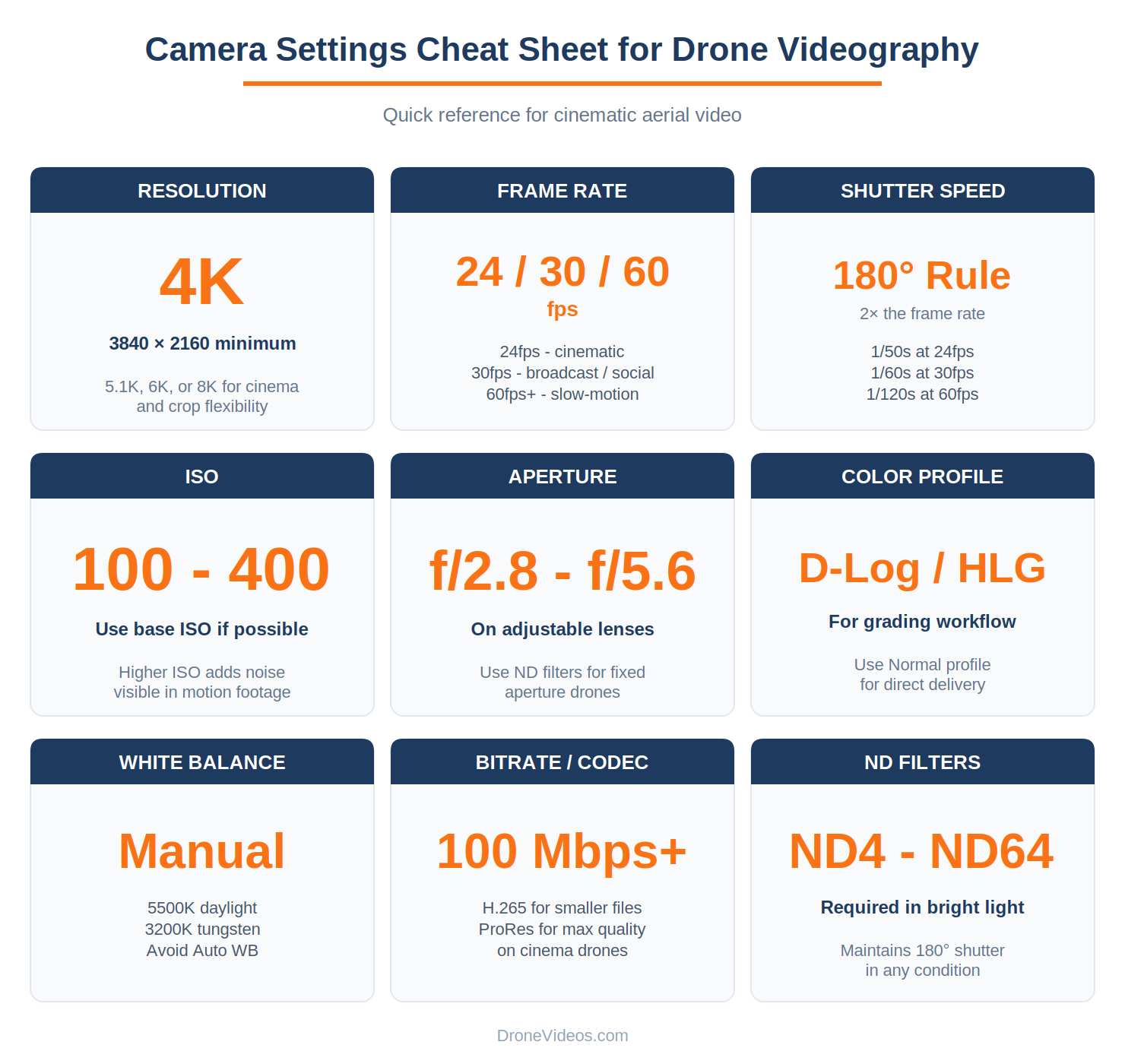
Best camera settings for drone videography:
- Resolution: Shoot in 4K at minimum (3840×2160). Higher-end drones support 5.1K, 6K, or 8K, which provide more flexibility for cropping and stabilization in post-production.
- Frame Rate: Use 24fps for cinematic projects, 30fps for broadcast and social media, 60fps for smooth motion or slow-motion in 30fps timelines, and 120fps or higher for dramatic slow-motion effects.
- Shutter Speed (180-Degree Rule): Set the shutter speed to roughly double the frame rate. For 24fps use 1/50s, for 30fps use 1/60s, for 60fps use 1/120s. This produces natural motion blur. ND filters are required to maintain these shutter speeds in bright conditions.
- ISO: Keep ISO as low as possible, ideally at base ISO (often 100 or 400 depending on the drone). Higher ISO introduces noise that is more visible in video than in still photos.
- Aperture: Use f/2.8 to f/5.6 on drones with adjustable aperture. Many drones have a fixed aperture, in which case ND filters become essential for exposure control.
- Color Profile: Use a flat or log profile such as D-Log, D-Log M, or HLG when color grading is planned. Use the standard or Normal profile when minimal editing is expected.
- White Balance: Set white balance manually (5500K for daylight, 3200K for tungsten) to maintain color consistency across clips. Avoid Auto White Balance, which causes color shifts mid-shot.
- Bitrate and Codec: Use the highest bitrate available, typically 100Mbps or higher. H.265 (HEVC) provides better quality at smaller file sizes than H.264, while ProRes and ProRes RAW (on cinema drones) provide maximum editing flexibility.
- ND Filters: Carry a set of ND4, ND8, ND16, ND32, and ND64 filters. ND filters reduce the light entering the sensor, allowing the correct shutter speed under bright conditions.
What Are the Best Drone Movement Techniques?
The best drone movement techniques produce smooth, intentional, and visually engaging footage that supports the story or subject. These techniques separate amateur drone video from professional aerial cinematography, and most rely on slow, deliberate stick inputs combined with proper drone configuration.
Best drone movement techniques for cinematic videography:
- Fly in Cinematic or Tripod Mode: Cinematic flight modes slow stick response, soften acceleration, and reduce yaw speed, producing fluid camera motion. Avoid Sport mode for finished video.
- Use Slow, Single-Axis Inputs: Move only one axis at a time when possible. A pure forward dolly looks more cinematic than a forward dolly combined with rotation and altitude change.
- Reveal With Reverse Pull-Out: Start close and low to a subject, then fly backward and upward simultaneously to reveal scale and surroundings.
- Master the Orbit: Use ActiveTrack or POI (Point of Interest) mode to automate consistent orbits at a fixed radius and speed.
- Add Parallax With Side Strafing: A sideways move past foreground objects creates depth through parallax, making the scene feel three-dimensional.
- Combine Tilt With Forward Motion: A slow forward dolly combined with a gradual gimbal tilt up produces a dramatic, story-building reveal.
- Plan Your Shot Before Takeoff: Identify the start frame and end frame mentally before starting the move. This prevents drifting, overshooting, and awkward stops.
- Avoid Sudden Stops: Decelerate gradually at the end of every move. Abrupt stops break visual flow and reveal the camera as a flying machine rather than an invisible observer.
What Equipment Is Used in Drone Videography?
Drone videography requires a combination of flight equipment, camera accessories, storage, and post-production tools. Each piece supports flight time, image quality, color consistency, and editing workflow. Selecting the right equipment is essential for producing professional-grade aerial footage. For more detail on related camera and lens gear, see the real estate photography equipment guide.
Essential equipment used in drone videography:
- Drone with Video-Capable Camera: Cinema drones such as the DJI Inspire 3 record full-frame ProRes RAW. Prosumer drones such as the DJI Mavic 4 Pro or Autel EVO II Pro record up to 5.1K or 6K. Consumer drones such as the DJI Air 3S or Mini 4 Pro record up to 4K.
- Remote Controller with Built-In Screen: A high-brightness controller such as the DJI RC 2 or RC Pro is necessary for shooting outdoors. Built-in screens are brighter and more reliable than smartphone displays.
- ND Filter Set: ND4, ND8, ND16, ND32, and ND64 filters allow proper shutter speeds in changing light. PolarPro and Freewell are leading filter brands.
- Multiple Batteries: Plan for at least 3 to 6 batteries per shoot day. Each battery provides 20 to 45 minutes of flight, but real-world usable time is typically lower due to safe landing reserves.
- Fast microSD or CFexpress Cards: V60 or V90 microSD cards are required for 4K at high bitrates. Cinema drones use CFexpress Type B cards for ProRes recording.
- External SSD for On-Set Backup: Cards fill quickly with high-bitrate video. A portable SSD such as the Samsung T9 or SanDisk Extreme Pro lets the operator offload and verify footage on location.
- Three-Axis Gimbal (Built In): Modern drones include integrated three-axis gimbals. Cinema drones offer interchangeable gimbal-and-camera systems such as the Zenmuse X9-8K Air.
- Hardshell Carrying Case: A protective case such as the Pelican Air or Nanuk shields the drone, batteries, and accessories during transport.
- Landing Pad: A portable landing pad keeps the drone clean during takeoff and landing in dusty or grassy areas.
- Video Editing Software: Adobe Premiere Pro, Final Cut Pro, and DaVinci Resolve are the standard editing platforms. DaVinci Resolve is particularly popular for color grading log and RAW footage.
- Color Grading LUTs: Lookup Tables provide a starting point for grading log footage. DJI publishes free official LUTs for D-Log and D-Log M.
What Are the Challenges of Drone Videography?
The main challenges of drone videography include environmental and technical limits, regulatory requirements, and creative or piloting demands. Understanding these challenges helps videographers plan more reliably and produce consistent footage across changing conditions.
3 main challenges of drone videography:
- Environmental and Technical Hurdles: Wind, rain, low light, and temperature extremes affect both flight stability and video quality. Battery life ranges from 20 to 45 minutes per pack, limiting continuous shooting time. Memory card speeds and capacities constrain how long high-bitrate or RAW footage can be recorded. Cold weather reduces battery performance, while heat triggers thermal throttling on the camera and gimbal.
- Legal and Regulatory Issues: Commercial drone videography in the United States requires an FAA Part 107 certificate, drone registration, and Remote ID compliance. Flights near airports, controlled airspace, or restricted zones require LAANC authorization. Many state and local jurisdictions add privacy and trespass rules on top of federal regulations. Productions involving people other than crew may also require talent releases and location permits.
- Creative and Piloting Challenges: Smooth video requires precise stick control, planned flight paths, and accurate framing through a small screen. Wind, GPS drift, and obstacle avoidance interruptions can ruin a take. Color grading log footage, syncing aerial clips with ground footage, and maintaining consistent exposure across multiple flights add complexity to post-production.
What Are the Benefits of Drone Videography?
The benefits of drone videography include cinematic perspective, stronger storytelling, lower production cost compared to helicopters, improved safety, higher production value, and broad application flexibility. These benefits explain why aerial footage has become a baseline expectation in commercial video production.
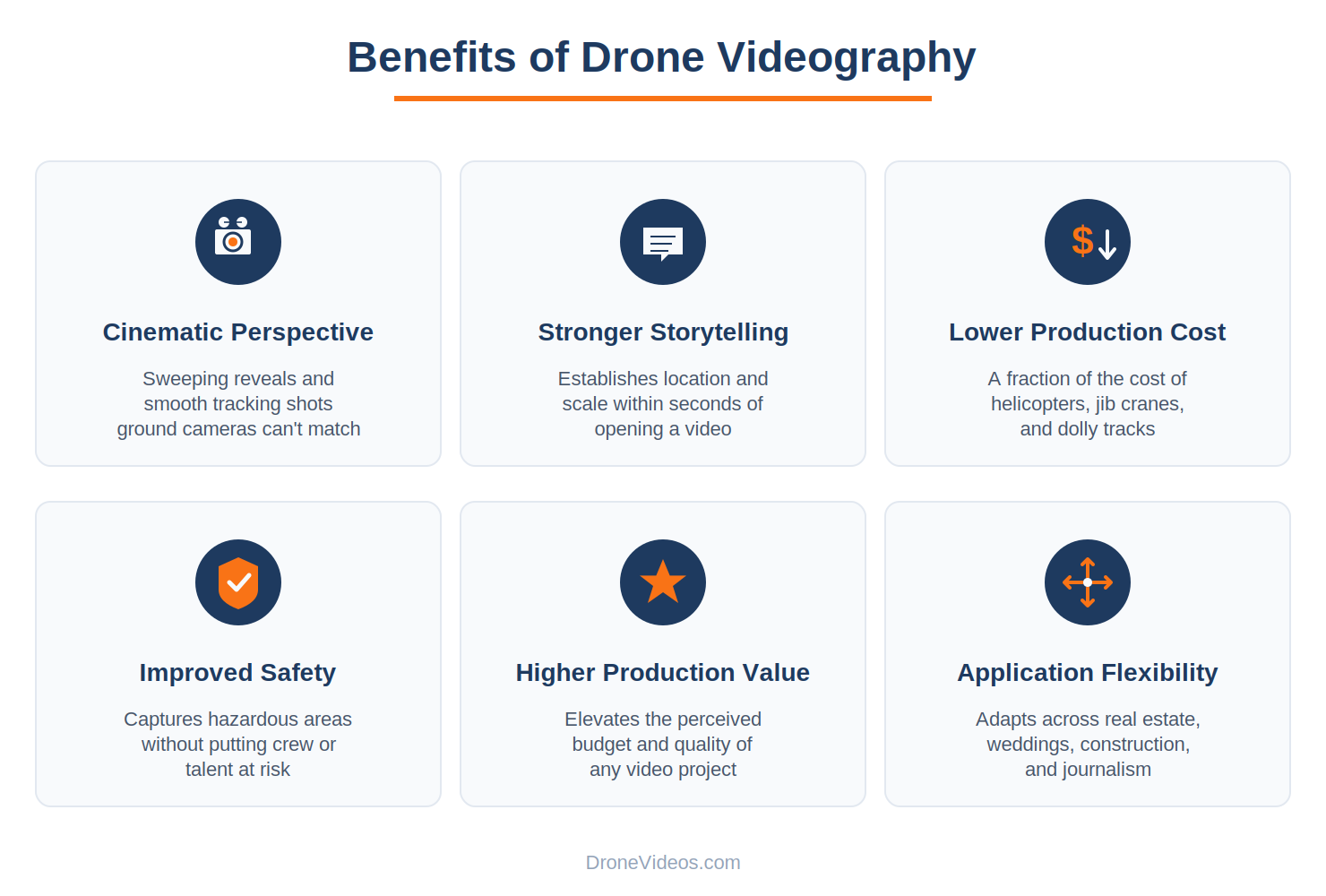
6 benefits of drone videography:
- Cinematic Perspective: Captures sweeping reveals, smooth orbits, and dynamic tracking shots that ground cameras cannot replicate, elevating the visual quality of any production.
- Stronger Storytelling: Aerial movement establishes location, scale, and atmosphere within seconds, allowing filmmakers and marketers to set the stage efficiently.
- Lower Production Cost: Replaces helicopters, jib cranes, and dolly tracks. A full drone videography day costs a fraction of traditional aerial cinematography.
- Improved Safety: Films hazardous environments such as construction sites, fires, cliffs, and crowded events without putting crew or talent at risk.
- Higher Production Value: A single well-executed aerial shot can transform the perceived budget and quality of a video, which is why aerial footage has become a baseline expectation in commercial work.
- Application Flexibility: Adapts to industries from real estate and weddings to construction, agriculture, journalism, and sports broadcasting.
What Technical Skills Does a Drone Pilot Need?
Becoming a skilled drone pilot requires more than the ability to fly. It demands a comprehensive understanding of both the technical and creative aspects of drone videography. Mastery of drone operation is fundamental, including pre-flight checks, flight path planning, and adapting to changing weather conditions to ensure safe and stable flights. A commercial drone pilot must be adept at adjusting camera settings such as ISO, shutter speed, and aperture to capture crisp aerial images and high-quality aerial footage in diverse lighting environments.
In addition to flying skills, proficiency in post-production techniques is essential. This includes editing drone footage using video editing software like Adobe Premiere Pro and DaVinci Resolve, where color grading and color correction can dramatically enhance the visual impact of aerial shots. Familiarity with Adobe Lightroom is also valuable for refining aerial photos and ensuring consistency across video projects. Understanding legal regulations is crucial for every drone pilot, especially when providing drone videography services for commercial purposes.
Regular practice flying in various environments, including complex weather conditions, sharpens piloting skills and prepares drone pilots for real-world challenges. Drone flight simulators are useful for practicing maneuvers in a risk-free environment before attempting them in complex shooting locations. By combining technical expertise, creative vision, and a commitment to safety, drone pilots deliver exceptional video footage that stands out in any industry.
What Are the Safety Rules and Regulations for Drone Videography?
Safety and regulatory compliance are fundamental aspects of responsible drone operation, particularly for commercial drone videography. Licensed drone operators must comply with strict guidelines set by aviation authorities such as the Federal Aviation Administration (FAA) in the United States or the Civil Aviation Authority (CAA) in the United Kingdom. For drone work involving real estate listings, see the real estate drone photography guide for an overview of FAA Part 107 compliance.
Key safety rules and regulations for drone videography:
- Hold the Required Pilot Certification: FAA Part 107 in the United States, the A2 CofC or GVC in the United Kingdom, and equivalent certifications in other jurisdictions are required for commercial drone operation.
- Register the Drone: Drones above the weight threshold (250 grams in the U.S. and most jurisdictions) must be registered with the relevant aviation authority.
- Comply with Remote ID Requirements: U.S. drones must broadcast Remote ID information during flight, identifying the aircraft and operator location.
- Respect Airspace Restrictions: Avoid no-fly zones, controlled airspace near airports, military bases, and emergency response areas. Use LAANC authorization for flights in controlled airspace.
- Maintain Visual Line of Sight: Keep the drone within unaided visual range at all times unless operating under a specific BVLOS waiver.
- Maintain Safe Distances: Stay clear of people, buildings, vehicles, and power lines that are not part of the operation.
- Check Weather Conditions: Wind, rain, and visibility directly affect flight safety. Most consumer drones are not rated for rain or sustained winds above 25 to 30 mph.
- Carry Liability Insurance: Commercial clients increasingly require proof of drone liability insurance, which covers property damage and injury claims arising from a drone operation.
- Respect Privacy Laws: Filming over private property without permission, capturing identifiable individuals without consent, or recording in restricted areas can lead to civil and criminal liability.
What Are the Best Practices for Drone Videography Post-Production?
Post-production is where raw drone footage is transformed into captivating, professional-grade videos that highlight the unique perspectives only aerial drone videography can provide. The process begins with organizing and reviewing all captured footage, then progresses through editing, color grading, sound design, and final delivery.
Best practices for drone videography post-production:
- Organize Footage Immediately After Each Flight: Back up cards to two separate drives, label clips by location and shot type, and review for keepers before the shoot day ends.
- Edit in Industry-Standard Software: Adobe Premiere Pro, DaVinci Resolve, and Final Cut Pro are the leading platforms. DaVinci Resolve is particularly strong for color grading log and RAW footage.
- Apply LUTs as a Starting Point: Use the manufacturer’s official Lookup Table (such as DJI’s D-Log to Rec.709 LUT) to convert flat log footage into a baseline color profile, then refine from there.
- Color Grade for Consistency: Match exposure, white balance, and tonal range across clips so the final video reads as a unified piece, not a collection of disconnected aerial shots.
- Stabilize Where Needed: Use software stabilization (Premiere’s Warp Stabilizer, Resolve’s stabilization tool) to smooth out minor wind effects, but rely primarily on in-camera stabilization for clean footage.
- Add Music, Sound Effects, and Voiceover: Sound design is critical because drones do not capture usable audio in flight. Pair aerial footage with licensed music and clean ambient sound for emotional resonance.
- Export for the Right Platform: Render multiple versions at different resolutions and aspect ratios (16:9 for YouTube, 9:16 for Reels, 1:1 for feeds) to maximize reach.
- Maintain a Long-Term Archive: Keep original camera files on archival storage so footage can be re-edited or relicensed years later.
How to Build a Career in Drone Videography?
Building a career in drone videography requires legal certification, technical skill, a focused portfolio, and consistent client acquisition. Most successful drone videographers specialize in one or two niches before expanding, which lets them charge higher rates and develop signature styles.
9 steps to build a career in drone videography:
- Get FAA Part 107 Certified: The FAA Part 107 Remote Pilot Certificate is required for commercial drone operation in the United States. The exam covers airspace, weather, regulations, and operations.
- Learn Video Fundamentals First: Frame rate, shutter speed, exposure, color theory, and basic editing apply to all video work. Strong fundamentals separate professionals from operators.
- Master One Drone Before Buying More: Spend 50 to 100 flight hours on a single drone before upgrading. Mastery of stick control, intelligent modes, and camera settings matters more than equipment.
- Build a Niche Portfolio: Create three to five complete projects in your target niche. A wedding videographer needs wedding films, not real estate flyovers. A focused portfolio attracts focused clients.
- Develop a Post-Production Workflow: Learn one editing platform deeply. Establish a color grading process, an export workflow for client delivery, and a backup system for raw footage.
- Set Clear Pricing: Decide between hourly, flat-rate, and package pricing for your target market. Research industry benchmarks and the drone real estate photography cost guide before quoting clients.
- Market Through SEO, Social, and Referrals: Maintain a portfolio website, post on Instagram, YouTube, and LinkedIn, and build referral relationships with photographers, agents, and event planners.
- Get Drone Insurance: Liability and hull coverage protect against crashes, property damage, and legal claims. Many commercial clients require proof of insurance before hiring.
- Stay Current with Technology and Regulations: Drone technology and FAA rules evolve continuously. Subscribe to industry newsletters, follow manufacturer announcements, and renew certifications on schedule.
Training and Certifications Required for Drone Videographers
Professional drone videographers in the United States must hold the FAA Part 107 Remote Pilot Certificate to operate commercially. Beyond this baseline, additional training in cinematography, editing, and specialized aerial techniques separates competitive professionals from average operators.
Training and certifications required for drone videographers:
- FAA Part 107 Certification: Mandatory for all commercial drone operations in the United States. Covers airspace classifications, weather, drone operations, regulations, and emergency procedures.
- TRUST Certificate: Required for recreational pilots flying under the Exception for Limited Recreational Operations.
- A2 CofC and GVC (UK): The A2 Certificate of Competency and General Visual Line of Sight Certificate are required for commercial drone operations in the United Kingdom.
- Hands-On Flight Training: Practice with manual flight modes, intelligent flight modes, and emergency procedures. Many operators benefit from formal flight schools or mentorship.
- Cinematography and Composition Training: Courses on shot composition, framing, color theory, and storytelling improve creative output.
- Video Editing and Color Grading Training: Proficiency in Premiere Pro, Final Cut Pro, or DaVinci Resolve, including log workflows and LUT application.
- Specialized Application Training: FPV flight schools, mapping and photogrammetry courses, and inspection certifications open higher-paying niches such as cinema FPV, drone surveying, and industrial inspections.
Frequently Asked Questions About Drone Videography
What is the difference between drone photography and drone videography?
Drone photography captures still images, while drone videography captures motion footage. Both use the same airframes and many of the same camera systems, but they require different camera settings, post-production workflows, and shot planning. Drone videography requires careful frame rate, shutter speed, and color profile selection, while drone photography prioritizes image resolution, dynamic range, and HDR bracketing. For more detail on still aerial work, see the drone photography guide.
How long does a drone videography shoot take?
A typical drone videography shoot takes 1 to 4 hours on site. Real estate projects usually take 1 to 2 hours, weddings and events take 2 to 4 hours, and commercial productions can span a full day or multiple days. Battery changes, weather pauses, and location moves all extend the on-site time, while post-production typically takes 2 to 5 times longer than the actual shoot.
Do you need a license to do drone videography?
Yes, anyone shooting drone videography for commercial purposes in the United States must hold an FAA Part 107 Remote Pilot Certificate. Hobbyists flying for personal use do not need Part 107 but must complete the TRUST exam and follow recreational drone rules. Other countries have equivalent requirements: the A2 CofC and GVC in the United Kingdom, the RPAS Pilot Certificate in Canada, and the EASA Open Category certifications in the European Union.
What is the best drone for videography?
The best drone for videography depends on the use case and budget. The DJI Inspire 3 is the leading cinema drone for high-end production, recording full-frame ProRes RAW. The DJI Mavic 4 Pro is the strongest prosumer choice for real estate, weddings, and commercial work. The DJI Air 3S and Mini 4 Pro are excellent entry-level options for solo creators, while the DJI Avata 2 is the leading factory FPV drone for immersive cinematic flying.
How much can a drone videographer earn?
Drone videographer earnings vary widely by experience, niche, and market. Entry-level operators charging $100 to $200 per hour earn $20,000 to $40,000 per year working part-time. Established commercial drone videographers in major markets earn $60,000 to $120,000 per year, while cinema drone operators on film and broadcast productions can earn $200,000 or more per year through high day rates and continuous bookings.
What file formats does drone videography use?
Drone videography typically records in MP4 or MOV containers, encoded with H.264 or H.265 (HEVC) codecs at 100Mbps or higher. Cinema drones such as the DJI Inspire 3 also record in ProRes 422 HQ and ProRes RAW at much higher bitrates, which provides greater editing flexibility but produces significantly larger files.
Can drones capture audio?
Drones cannot capture usable audio in flight because the propellers produce too much noise. All sound in finished drone videos is added in post-production, including licensed music, voiceover, and ambient sound recorded separately on the ground. Some FPV pilots use external microphones for narration but rely on post-production sound design for the final soundtrack.